
The Georgia Inmate Population
The statewide phrase "Georgia inmate population" does not describe one database. GDC reports state-prison and state-corrections counts; county sheriffs maintain jail rosters for local and pretrial custody; the Georgia Sheriffs' Association publishes a statewide county-jail monthly report source; BOP maintains federal-prison custody; ICE maintains immigration detention lookup; and Georgia VINE/VINELink provides notification. Those systems overlap in public interest but not in agency control.
The Georgia Department of Corrections home page is the statewide starting point for GDC mission, offender search, facility search, and report access.
That source anchors the state-prison side of the Georgia inmate population before the search branches into local jail, federal, immigration, and notification systems.
The latest researched GDC FY 2026 Average Counts Summary reports average daily State Prisons capacity of 37,799 and State Prisons on-hand population of 35,531 for July 1, 2025 through June 30, 2026, printed July 1, 2026. That figure is the state-prison slice of the Georgia inmate population, not the complete statewide jail count. The same GDC report lists other state-corrections facility types separately: County Prisons, Transitional Centers, Private Prisons, Detention Centers, and RSAT Centers.
Georgia Inmate Population Statistics
Georgia's statewide inmate numbers need labels because "jail," "prison," and "corrections" are different counts. GDC's FY 2026 average daily population report lists State Prisons on hand at 35,531. It also lists County Prisons at 4,203, Transitional Centers at 2,684, Private Prisons at 8,075, Detention Centers at 1,450, and RSAT Centers at 1,484 on hand. County jail population and capacity are reported through the Georgia Sheriffs' Association jail-report channel, not through a single GDC jail roster.
The Georgia Sheriffs' Association jail-report page is the statewide source identified in the research for county-jail population and capacity reporting.
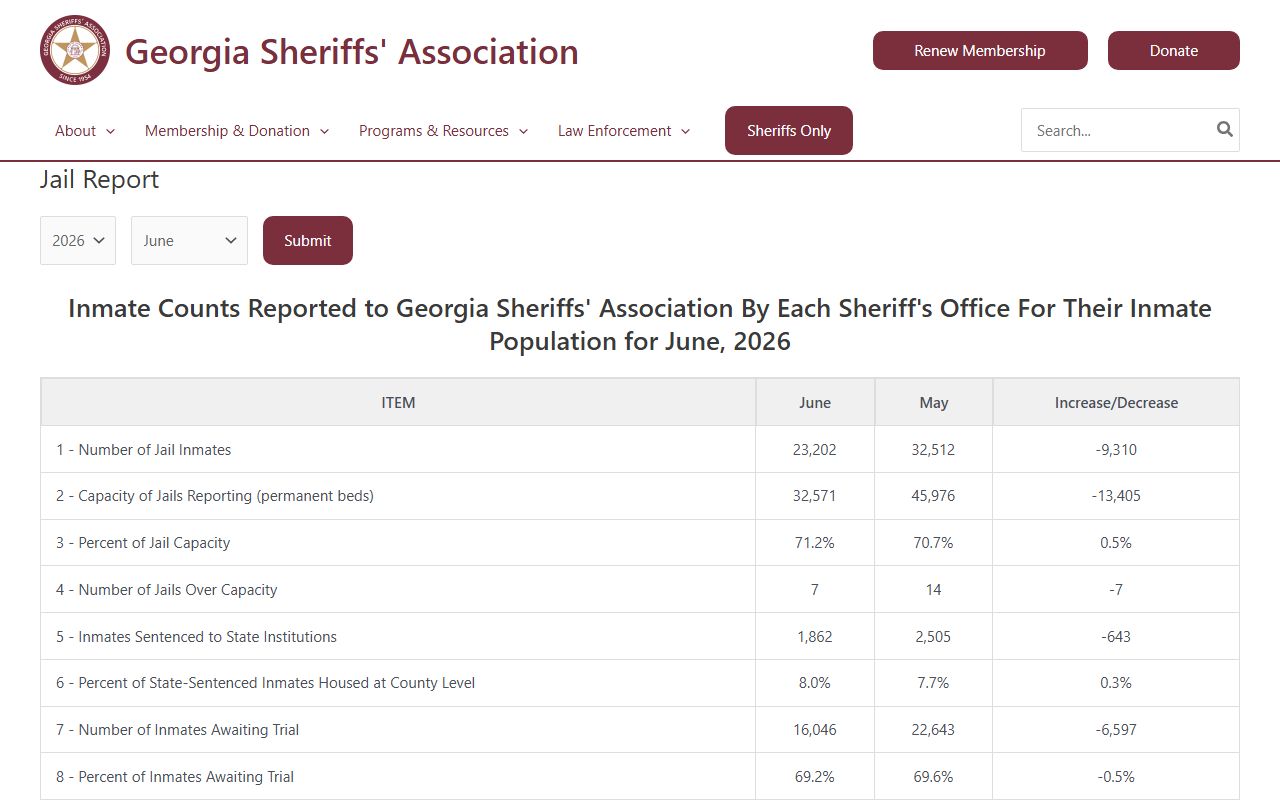
Keeping that jail-report source separate from GDC prison counts prevents the statewide totals from being merged into one unsupported number.
| Measure | Figure | Source / Date |
|---|---|---|
| State Prisons average on hand | 35,531 | GDC FY 2026 Average Counts Summary, printed July 1, 2026 |
| State Prisons capacity | 37,799 | GDC FY 2026 Average Counts Summary |
| County Prisons average on hand | 4,203 | GDC FY 2026 Average Counts Summary |
| Private Prisons average on hand | 8,075 | GDC FY 2026 Average Counts Summary |
| Transitional Centers average on hand | 2,684 | GDC FY 2026 Average Counts Summary |
Georgia Inmate Population Trends
GDC's comparable State Prisons average on-hand count increased from 35,369 in FY 2025 to 35,531 in FY 2026, a rise of 162. Private-prison average on hand increased from 7,689 to 8,075, while county-prison average on hand decreased from 4,470 to 4,203. GDC's 2025 Annual Fiscal Report adds longer context: from FY 2012 through FY 2025 annual admissions dropped from 19,032 to 13,973, annual releases dropped from 20,634 to 13,532, and releases fell below admissions, contributing to an increasing overall offender population.
The trend also shows why a statewide Georgia inmate population page needs more than a live lookup box. Admissions, releases, county-prison use, private-prison use, and transitional-center placement move at different speeds. A person may be counted in one GDC facility type for a report period, then later appear in a county jail roster, a parole record, or a DCS supervision record. Readers comparing annual counts should use the same category from the same source before drawing conclusions about growth or decline.
| Period | State Prisons On Hand | Note |
|---|---|---|
| FY 2025 | 35,369 | GDC average daily State Prisons on hand |
| FY 2026 | 35,531 | Comparable GDC average increased by 162 |
Who Makes Up the Georgia Inmate Population
The Georgia inmate population includes several custody layers. County jails hold people booked after arrest, pretrial detainees, local-sentence detainees, people awaiting transfer, state-sentenced inmates awaiting pickup, and holds for other agencies depending on local agreements. GDC facilities hold sentenced state offenders, transitional-center residents, probation detention-center residents, RSAT/treatment populations, and people in private or contract prison beds. BOP and ICE facilities are separate federal and immigration systems.
- County jail custody: search the sheriff or jail roster for the county that booked or holds the person.
- State correctional custody: search GDC Offender Query for active or inactive GDC records.
- Federal custody: search the BOP inmate locator, including Georgia entries such as FCI Atlanta and FCI Jesup.
- Immigration detention: search ICE ODLS for facilities such as Stewart Detention Center and Folkston ICE Processing Center.
Laws Governing Georgia Inmate Records
Georgia's Open Records Act, O.C.G.A. Section 50-18-70 et seq., is the statewide public-records framework cited by GDC. GDC says most government records are available to the public, but it also identifies common exceptions for correctional records, including offender central-office and institutional files, disciplinary reports, grievances, housing assignments, phone-call information and emails, security classifications, Office of Professional Standards investigations, employee personal information, safety-sensitive policies, and offender medical or mental-health records without proper consent.
Georgia's public-records rule is a custodian rule. GDC can respond for GDC records, but it does not become the custodian of every county jail booking sheet or every clerk's criminal docket. County sheriffs, municipal courts, superior court clerks, state courts, magistrate courts, BOP, ICE, and the Parole Board each control their own records. That division matters when a person is trying to verify a bond, a release, a state-prison location, a parole month, or a court disposition.
Request route: GDC prison records go through the GDC open-records portal; county jail booking records go to the sheriff or county custodian; court records go to the clerk or Georgia Courts e-access provider route; BOP and ICE records use their own federal channels.
The Georgia State Prison System
The Georgia Department of Corrections, abbreviated GDC, is the state correctional agency for Georgia's sentenced state-prison population. GDC's State Prisons page says the department has 34 state prisons across Georgia and explains security levels through the Next Generation Assessment. Close Security offenders are described as escape risks, people with assault histories, or people with serious detainers who require correctional-officer supervision. Medium Security is the largest category, and Minimum Security offenders may be eligible for transitional centers.
The GDC State Prisons overview is the researched source for state-prison classification language and security-level context.
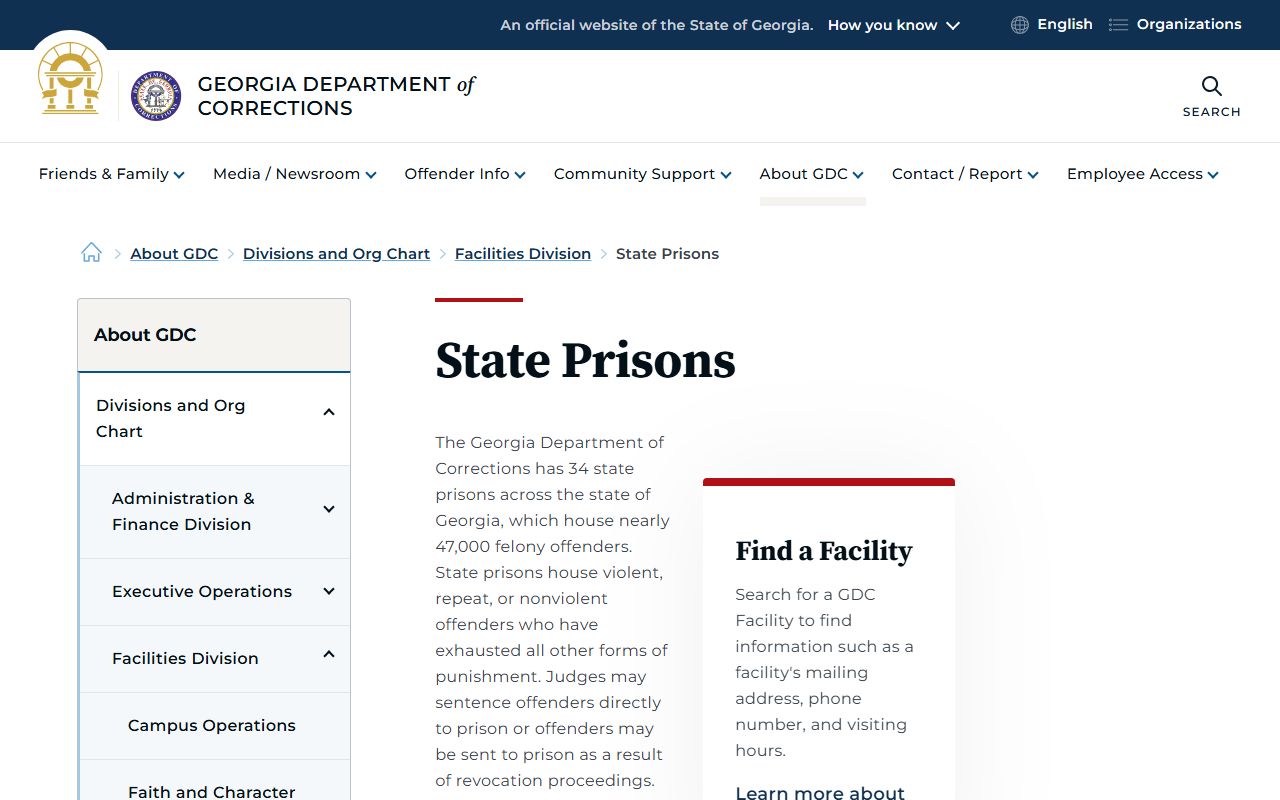
The classification page explains why a GDC prison search is different from a county booking search: it is organized around sentenced state custody and facility assignment.
How to Search the Georgia Inmate Population
A statewide Georgia inmate search should start with custody type, not only with a name. A person arrested today usually appears first in a county jail system. A sentenced state offender should be searched through GDC. A federal sentence requires BOP, and immigration detention requires ICE ODLS. VINE/VINELink is useful for custody-status alerts, but it is not a substitute for the official roster or locator that controls the record.
Use the county where the arrest occurred when the matter is still local. Use conviction county, GDC ID, case number, or most recent institution when the person has moved into state correctional custody. Use a BOP register number, FBI number, DCDC number, INS number, or federal name search for federal custody. Use an A-Number and country of birth, or the biographical search route, for ICE detention. These search fields come from separate systems, so a failed result in one system often means the search belongs somewhere else.
For state custody, GDC's public Find an Offender page is the researched entry point to the offender search.
The page is useful for state-prison searches, but the surrounding decision path still matters because county bookings, BOP custody, and ICE custody use different systems.
- For state correctional custody, use the GDC Offender Query.
- For a recent arrest or pretrial hold, choose the county in the County Directory and use that jail's roster route.
- For a specific jail, prison, ICE site, or federal prison, browse the Facility Directory.
- For federal inmates, use the BOP inmate locator.
- For immigration detention, use ICE ODLS; for alerts, use Georgia VINE/VINELink.
Georgia Inmate Search by County
County jail rosters remain the practical starting point for local custody because Georgia does not have one public statewide jail roster that replaces each sheriff's jail system. Pick the county that booked the person, filed the hold, or physically houses them. If the person has moved after conviction, revocation, or transfer, switch to GDC or the appropriate federal or immigration locator.
The county directory is also the safest way to handle Georgia's uneven roster formats. Some counties publish a searchable roster. Others route users through a sheriff page, a jail vendor, a daily booking report, a records office, or a phone and in-person records path. A county page can explain that local route without pretending that every Georgia jail uses the same fields, refresh schedule, photo policy, or release-status language.
The direct GDC Offender Query form shows why state searches are not the same as county roster searches.
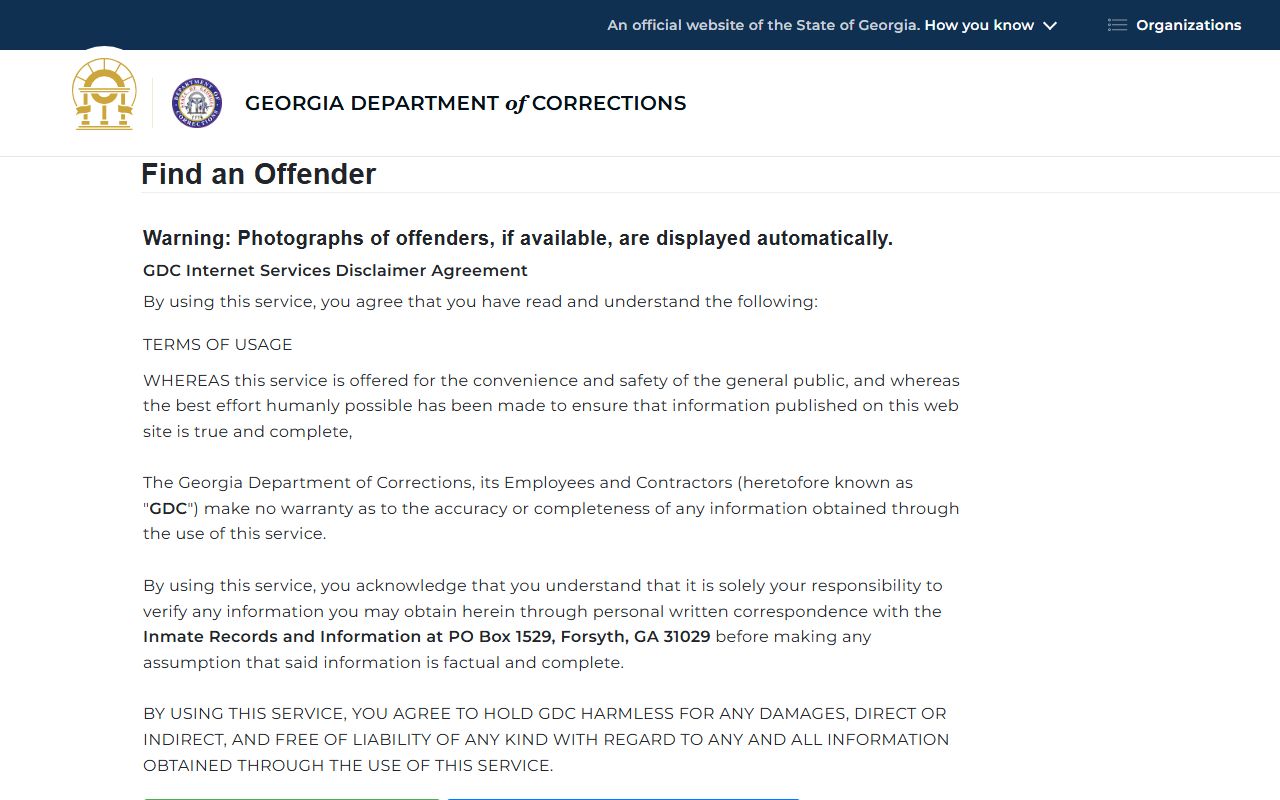
Its name, ID, case-number, active-status, conviction-county, and institution filters are state-record tools, while county pages remain the route for local jail custody.
Georgia Jails, Prisons, and Detention Facilities
Georgia's detention geography includes county jails, county correctional institutions, GDC state prisons, transitional centers, probation detention centers, RSAT and treatment facilities, private state-prison contract facilities, federal prisons, and ICE detention centers. The statewide facility directory keeps those rows separated so a jail roster is not confused with a GDC locator, BOP locator, or ICE search.
That separation is important in Georgia because GDC's own locations directory can show county jails and county correctional institutions beside state prisons and transitional centers. The facility name alone does not tell a user which roster controls the current record. A county jail row usually routes to the county sheriff or local jail page. A state prison, detention center, transitional center, RSAT facility, or private state-prison contract row usually routes through GDC. A federal or ICE row belongs to a federal locator.
The GDC facility directory is one statewide source for Georgia correctional facilities, including GDC locations and some county-linked rows.
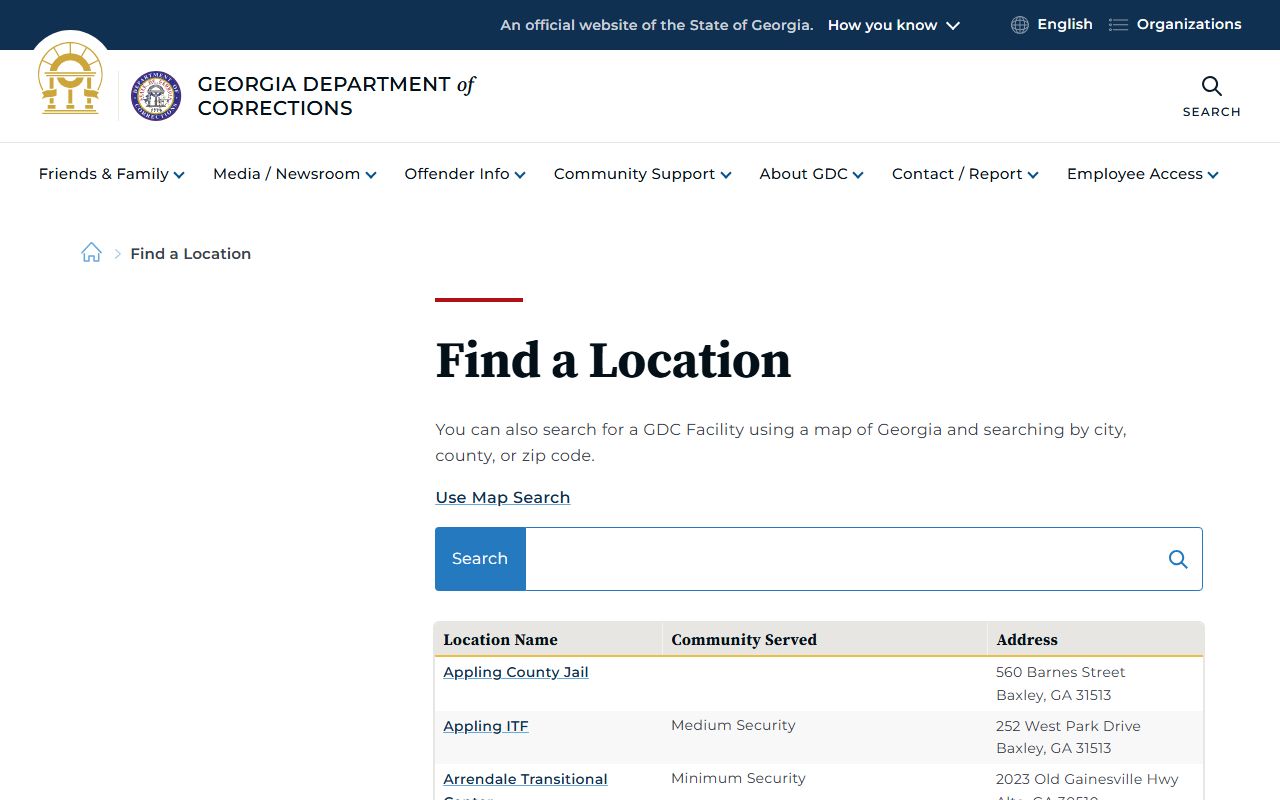
That directory helps identify state facilities, but the facility directory here also separates county jails, federal prisons, and ICE detention locations by custody route.
For federal custody, the Federal Bureau of Prisons inmate locator is the relevant national source for federal inmates in Georgia facilities such as FCI Atlanta and FCI Jesup.
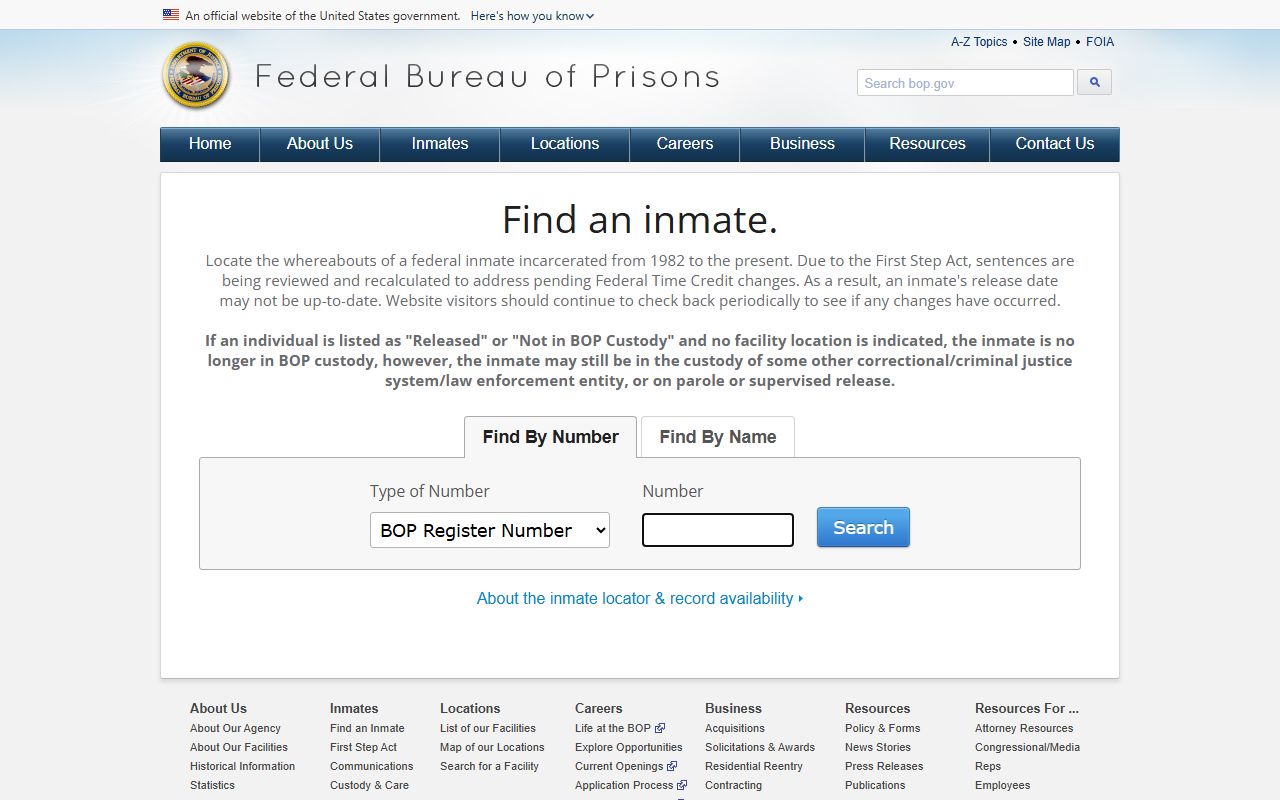
The BOP locator belongs beside, not inside, the county and GDC search paths because federal custody is maintained by a separate agency.
For custody alerts and victim notification, the researched statewide entry is Georgia VINE/VINELink.

VINE is useful for notification, while the source roster or locator remains the place to verify the underlying custody record.
When the question moves from custody to filed cases, the Georgia Courts e-access page is the statewide court-record routing source identified in the research.
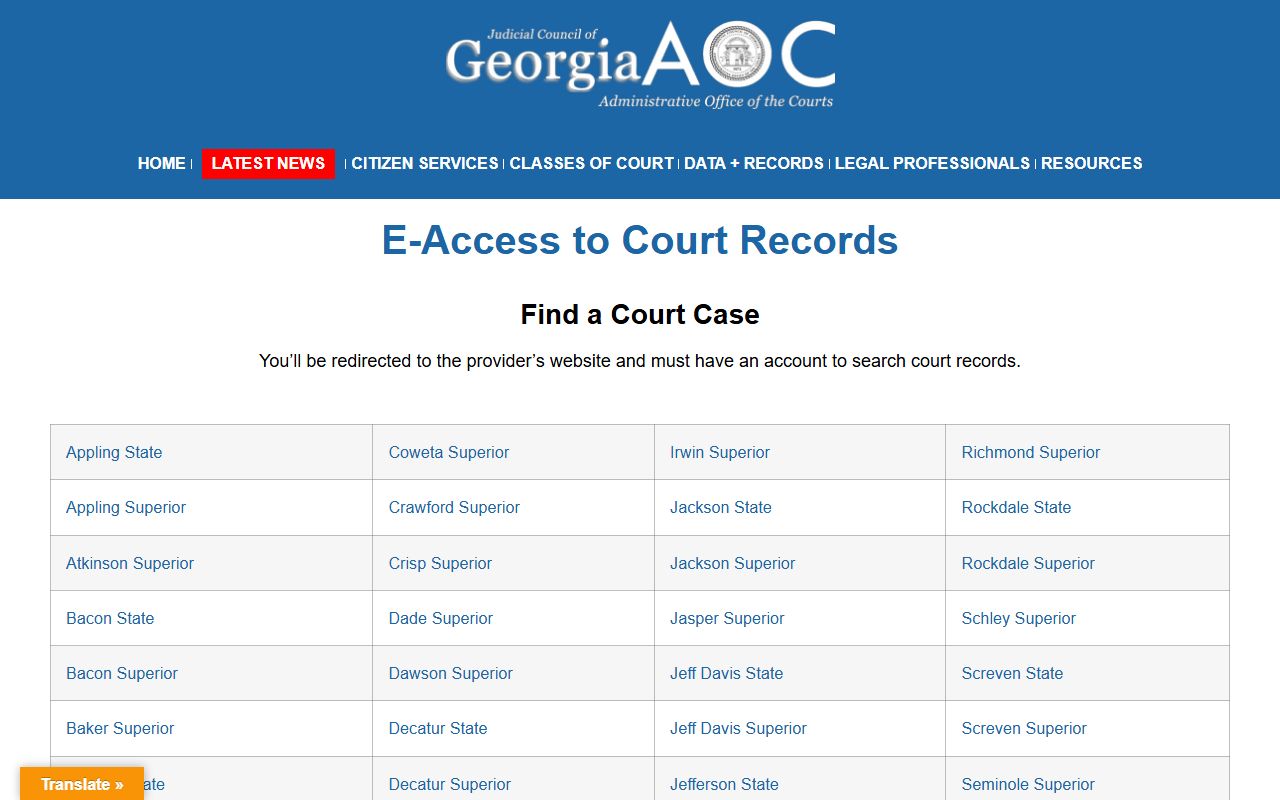
That court gateway reinforces the main search rule: custody records and court records are connected, but they are maintained in different systems.
Georgia Inmate Population FAQ
How big is the Georgia inmate population?
The researched statewide prison figure is GDC's FY 2026 State Prisons average on-hand count of 35,531. That does not include every person in every county jail. County jail population and capacity are tracked separately through Georgia Sheriffs' Association jail reports and local sheriff systems.
Why does a county jail appear in GDC systems?
Georgia's GDC facility directory and offender query can reference county jails or county institutions because state records may involve conviction county, most recent institution, state-sentenced people awaiting transfer, or institutional history. That does not make GDC the live county jail roster.
Where should a same-day arrest search start?
Start with the county jail for the county that booked or holds the person. GDC becomes the correct route after state correctional custody begins or when an offender has a GDC record.
Public Record Search
Sponsored Results