
What Is GDC? Georgia Department of Corrections
GDC is the official abbreviation used by the Georgia Department of Corrections on its home page, offender-query page, and disclaimer. The agency runs Georgia's state correctional system and maintains the offender query used for state custody and GDC offender records. GDC is not a county sheriff's office and does not replace the jail roster for a person who has just been arrested locally.
GDC's facility footprint includes state prisons, transitional centers, detention centers, RSAT and treatment facilities, probation detention centers, and private or contract prison rows. The GDC facility directory also includes some county jails and county correctional institutions, which can confuse users. A county jail appearing in a GDC facility list does not mean GDC is the live county booking roster.
The best practical test is custody stage. If the person is still in a county booking cycle, awaiting first appearance, waiting on bond, or held before trial, the county jail remains the first source. If a sentence, revocation, state detention placement, transitional-center placement, probation detention-center placement, or prior state custody record is involved, GDC becomes the statewide source. That distinction keeps the GDC inmate population from being confused with every person in a Georgia jail on the same day.
The GDC Inmate Population
The latest researched GDC FY 2026 Average Counts Summary reports State Prisons capacity of 37,799 and average on-hand population of 35,531 for July 1, 2025 through June 30, 2026, printed July 1, 2026. The same report lists County Prisons at 4,203, Transitional Centers at 2,684, Private Prisons at 8,075, Detention Centers at 1,450, and RSAT Centers at 1,484 on hand. Those categories should be described separately instead of collapsed into a single unsourced total.
State Prisons is the headline GDC inmate population category for secure state-prison custody, but it is not the only GDC-related count a user may see. Transitional centers focus on reentry. Detention centers and RSAT centers serve different state correctional functions. County prison rows are not the same as a sheriff's public booking roster. Private prison rows are state correctional arrangements rather than county jail systems. Keeping those categories separate helps readers compare GDC population reports without mixing unlike custody types.
| GDC category | FY 2026 average on hand | Source |
|---|---|---|
| State Prisons | 35,531 | GDC FY 2026 Average Counts Summary |
| County Prisons | 4,203 | GDC FY 2026 Average Counts Summary |
| Transitional Centers | 2,684 | GDC FY 2026 Average Counts Summary |
| Private Prisons | 8,075 | GDC FY 2026 Average Counts Summary |
| Detention Centers | 1,450 | GDC FY 2026 Average Counts Summary |
| RSAT Centers | 1,484 | GDC FY 2026 Average Counts Summary |
How to Search the GDC Inmate Locator
The official GDC inmate locator is the GDC Offender Query, also reached through GDC's public Find an Offender page. The GDC disclaimer says the service is offered for convenience and public safety, makes no warranty as to accuracy or completeness, and advises written verification through Inmate Records and Information at PO Box 1529, Forsyth, GA 31029 before assuming information is factual and complete. It also warns that photographs, if available, display automatically.
GDC's public Find an Offender page is the front-door source for explaining that the search is used to find an offender currently in a GDC facility.
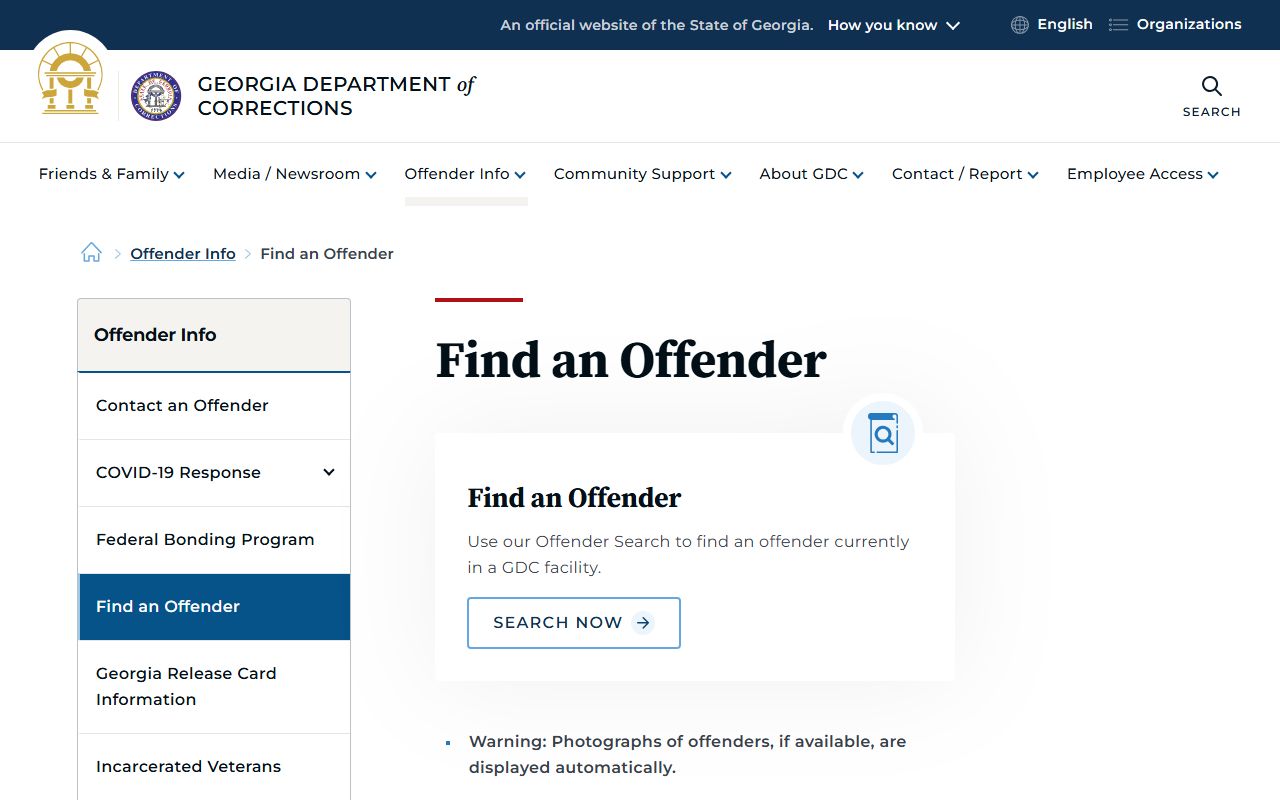
The landing page keeps the GDC inmate locator in its correct lane: state correctional custody, not a universal county arrest search.
The direct GDC Offender Query form shows the disclaimer and the statewide search fields used after the user accepts the notice.
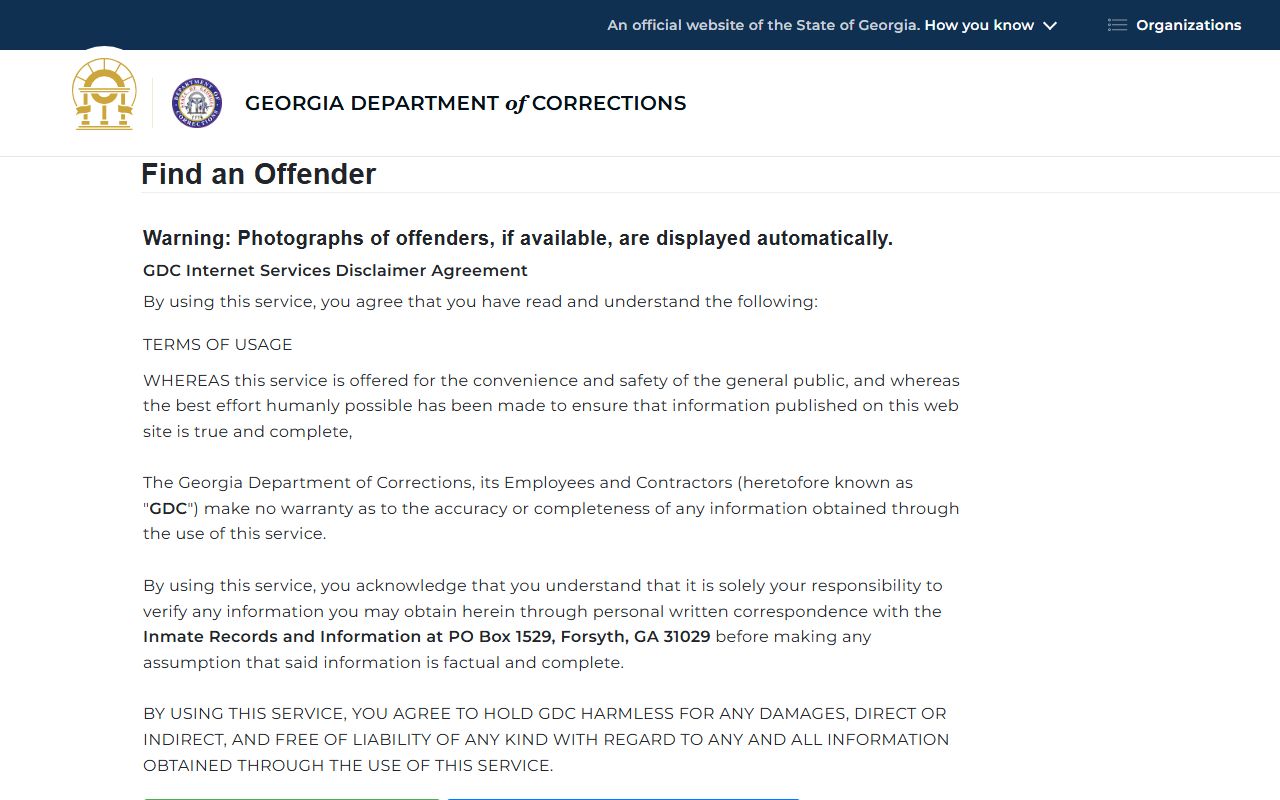
Those fields support ID, case-number, name, active-status, offense, conviction-county, and institution searches for GDC records.
- Open GDC Find an Offender or the direct Offender Query.
- Read and accept the GDC disclaimer.
- Search by GDC ID number or case number when available.
- If no ID is available, search by last name and first name, then narrow by gender, race, age, conviction county, most recent institution, primary offense, or sentence status.
- Use "Only Active Offenders" for current GDC custody; use active and inactive scope when prior GDC records are relevant.
- Use the Parole Board search when parole, pardon, or TPM status is the question.
What a GDC Inmate Record Shows
The GDC search form supports name and description searches, ID and case-number searches, active/inactive scope, photo and no-photo result options, and records-per-page controls. Research found the form warns that a maximum of 150 records per query will be returned unless upcoming or recent releases are selected under sentence status. Result details can include identifying information, GDC ID, most recent institution, current status, aliases, sentence records, release dates, major offense, and incarceration history when available.
The form also shows why a narrow search can be more reliable than a broad name-only query. A common last name may return too many results or hit the 150-record limit. GDC ID, case number, conviction county, most recent institution, sentence status, age range, physical descriptors, or active/inactive scope can narrow the list. The photo option changes how many records appear per page, so a user who does not need photos may see more results at once.
| Field | Use |
|---|---|
| GDC ID Number | Best identifier for a state offender when known. |
| Case Number | Alternative numeric search path when available. |
| Most Recent Institution | Helps distinguish current or prior GDC facility routing. |
| Sentence Status | Can narrow active, inactive, release, or sentence-related searches. |
| Conviction County | Useful when a common name returns too many results. |
GDC Prisons and Facilities
GDC's state-prison page explains that offenders are assigned security levels through the Next Generation Assessment, using factors such as sentence, nature of crime, criminal history, history of violence, and medical or treatment needs. Close Security offenders require constant correctional-officer supervision and do not leave the prison. Medium Security is the largest category. Minimum Security offenders generally present minimal escape risk and may be eligible for transitional centers.
The GDC State Prisons overview is the source for the state-prison classification discussion.
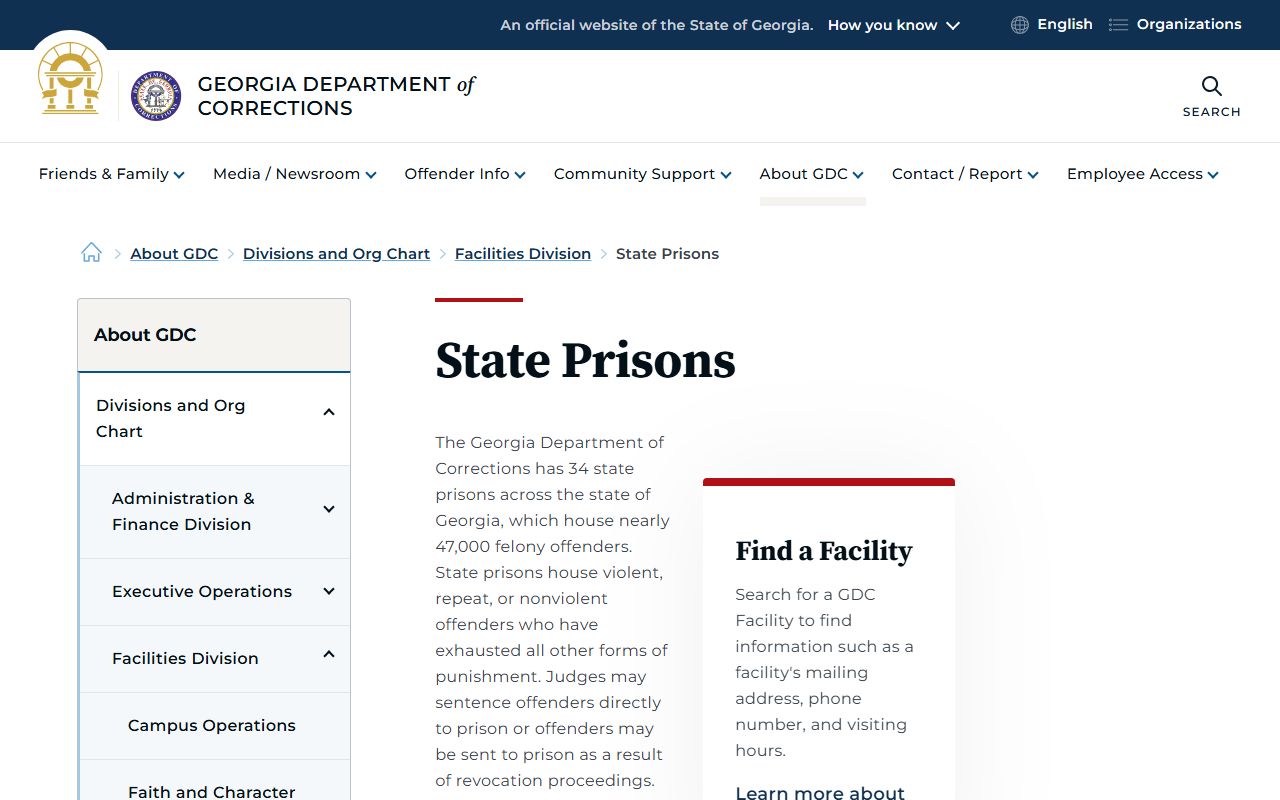
That classification source explains why state-prison placement depends on risk, sentence, criminal history, violence history, and treatment needs.
For facility lookup, the GDC locations directory is the official directory source captured in the manifest.
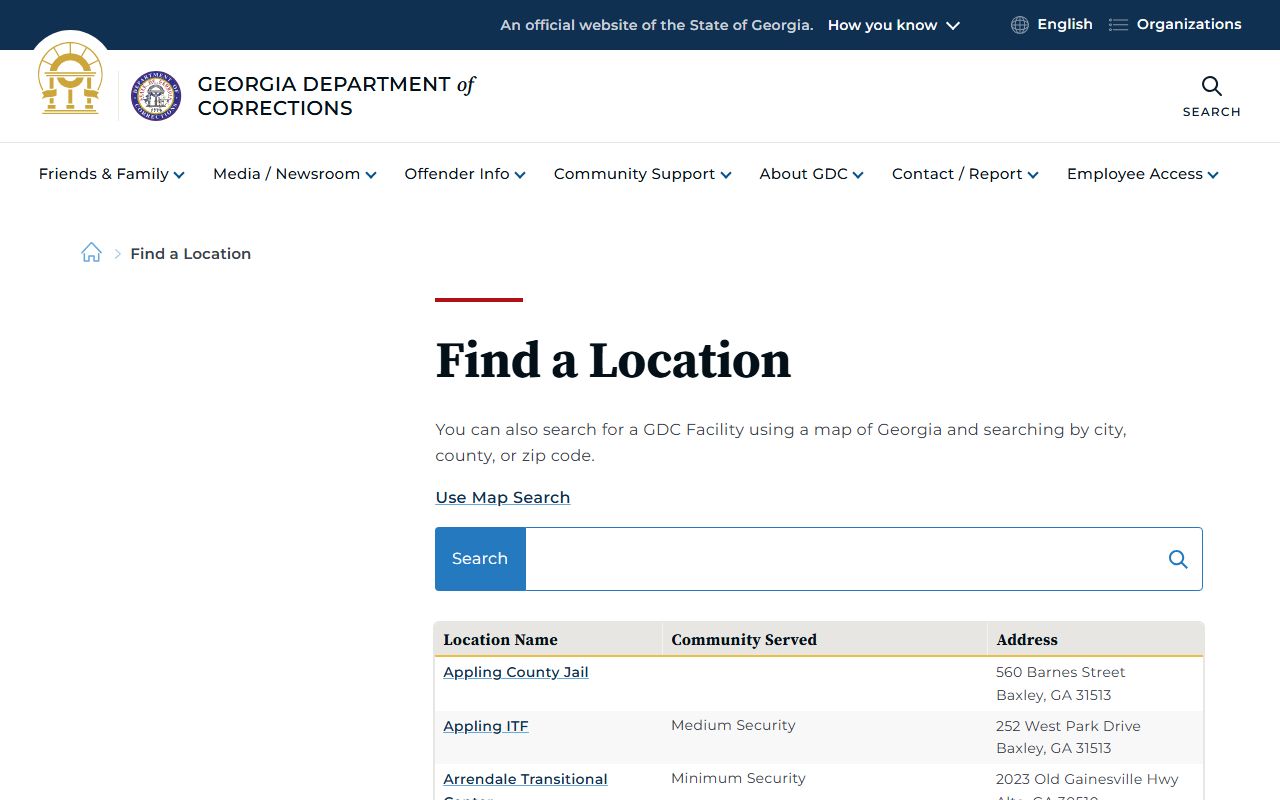
The GDC directory helps locate state correctional facilities, while the statewide facility directory also separates county, federal, and ICE detention rows.
Georgia's GDC-related facility rows include major state prisons such as GA Diagnostic and Classification Prison, Hays State Prison, Hancock State Prison, Smith State Prison, Telfair State Prison, Ware State Prison, Valdosta State Prison, Wilcox State Prison, Washington State Prison, Walker State Prison, Lee State Prison, Central State Prison, Macon State Prison, Calhoun State Prison, Dodge State Prison, Dooly State Prison, Baldwin State Prison, Autry State Prison, Coastal State Prison, Lee Arrendale State Prison, Rogers State Prison, and Phillips State Prison. The statewide Facility Directory also includes county jails, federal facilities, ICE detention, and uncovered basic GDC rows from the research.
GDC Inmate Population Trends
The GDC inmate population trend differs by facility type. GDC's FY 2025 Average Counts Summary listed State Prisons on hand at 35,369; FY 2026 listed State Prisons on hand at 35,531, an increase of 162. Private-prison average on hand increased from 7,689 to 8,075, while county-prison average decreased from 4,470 to 4,203. GDC's 2025 Annual Fiscal Report adds that annual admissions dropped 27 percent from 19,032 to 13,973 from FY 2012 through FY 2025, while annual releases dropped 34 percent from 20,634 to 13,532.
| Measure | FY 2025 | FY 2026 |
|---|---|---|
| State Prisons on hand | 35,369 | 35,531 |
| Private Prisons on hand | 7,689 | 8,075 |
| County Prisons on hand | 4,470 | 4,203 |
Sentencing, Parole, and Release in GDC Custody
Georgia sentencing and release are split among courts, GDC, the State Board of Pardons and Paroles, and the Department of Community Supervision. Courts impose sentences. GDC houses sentenced offenders and maintains prison records. The Parole Board decides parole for eligible inmates. DCS supervises parolees and other felony-supervision populations in the community.
The State Board of Pardons and Paroles TPM lookup explanation is the researched source for Tentative Parole Month context.
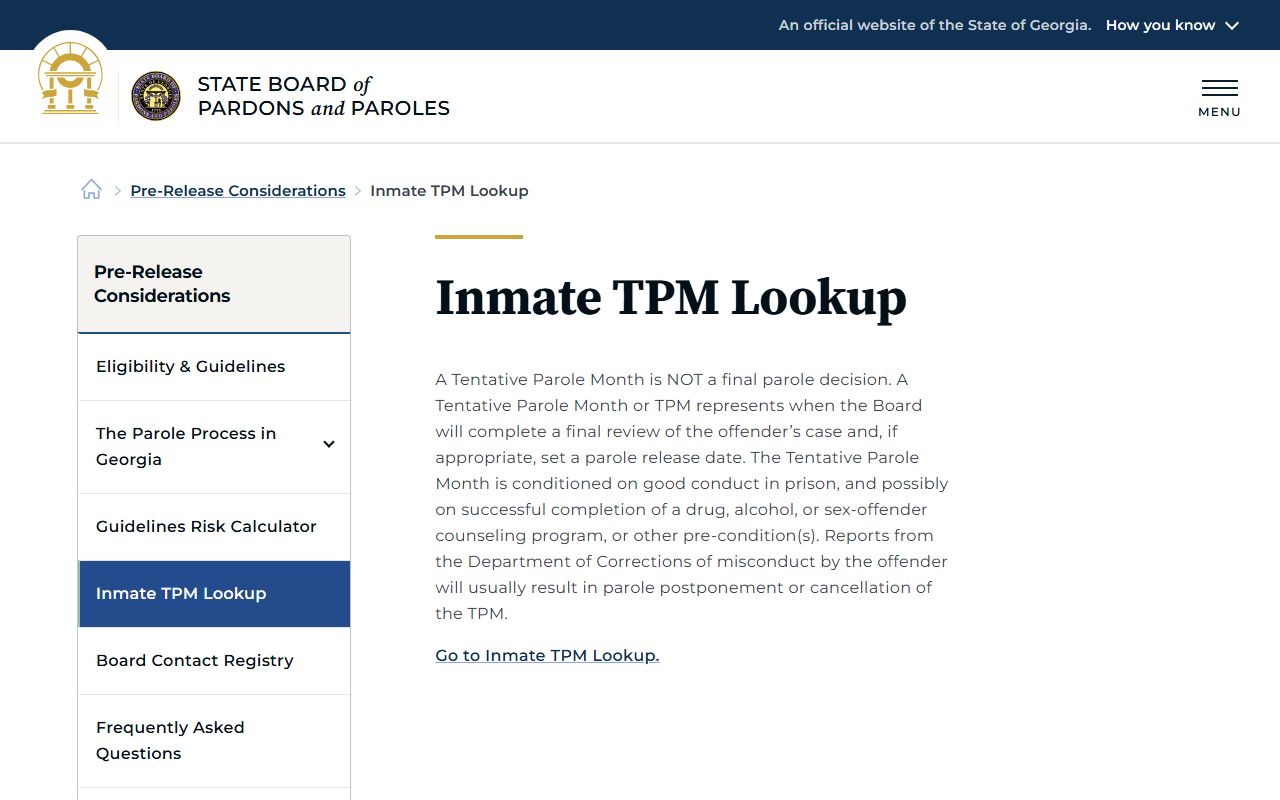
The parole screenshot belongs on the GDC page because release timing often requires both GDC custody records and Parole Board status information.
The Parole Board explains that a Tentative Parole Month is not a final parole decision. It is the month when the Board expects to complete final review and, if appropriate, set a parole release date. GDC's Performance Incentive Credit program can allow eligible offenders to accumulate up to 12 points and potentially receive 1 to 12 months off a Tentative Parole Month or Maximum Release Date, based on case plan, education/vocational improvement, and detail/work assignment points. That should not be simplified into automatic good time.
For a family member, the practical release check may require more than one source. GDC can show current institution, state offender identifiers, and sentence-related fields. The Parole Board can show parole or TPM context. DCS becomes relevant after release to parole or felony supervision. County jail staff usually cannot answer state-prison parole timing, and GDC cannot turn a tentative parole month into a guaranteed release date.
GDC vs. County Jail: Where to Look
The GDC inmate population is the state correctional side of Georgia custody. County jails are the starting point for recent arrests, pretrial custody, local jail sentences, and people awaiting transfer. GDC becomes the right search route after state correctional custody begins or when an offender has a GDC record.
| GDC | County Jail | |
|---|---|---|
| Who is held | State correctional offenders and GDC facility populations | Recent bookings, pretrial detainees, local sentences, holds, and transfers |
| Run by | Georgia Department of Corrections | County sheriff or local jail authority |
| Where to search | GDC Offender Query | County jail roster through the County Directory |
GDC Records Requests
GDC directs open-records requests through its Open Records Request portal and cites Georgia's Open Records Act, O.C.G.A. Section 50-18-70 et seq. GDC says it has three business days to provide an initial response. Non-medical document copies are $0.10 each, and searching or redacting records is billed at the hourly rate of the lowest-paid qualified employee. Common exceptions include institutional files, disciplinary reports, grievances, housing assignments, phone-call information and emails, security classifications, investigations, employee personal information, safety-sensitive policies, and offender medical or mental-health records without HIPAA-compliant consent.
The GDC open-records request page is the captured source for the prison-records request route and exceptions.
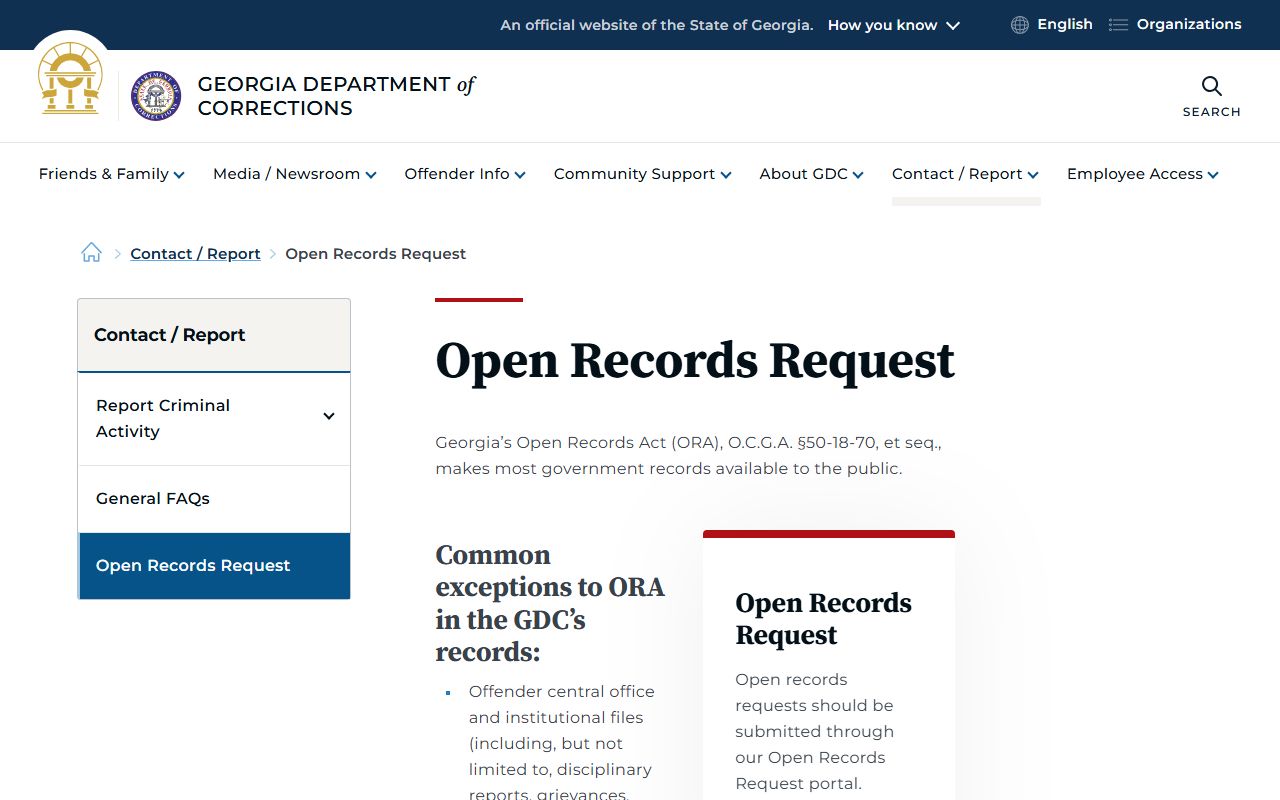
That records page is the correct source for GDC records; county jail bookings, courts, BOP, and ICE records require their own custodians.
A useful GDC request should be specific. Include the person's full name, GDC ID if known, facility, date range, and the record type requested. Requests for county booking sheets, court documents, federal prison records, immigration detention records, or criminal-history reports should not be sent to GDC unless the record is actually maintained by GDC. Georgia government sources also explain that agencies do not have to create a new report, summary, or compilation when no existing record matches the request.
GDC Inmate Population FAQ
How large is the GDC inmate population?
The researched headline state-prison figure is 35,531 average on hand in State Prisons for FY 2026, with State Prisons capacity reported as 37,799 in the same GDC summary.
Is the GDC inmate locator the same as a county jail roster?
No. The GDC inmate locator searches GDC offender records. County jail rosters are maintained locally by the county jail or sheriff.
What if a GDC search does not find a person recently arrested?
Search the county jail first. A recent arrest or pretrial hold may not be in GDC custody unless the person has entered the state correctional system or has a relevant GDC record.
Public Record Search
Sponsored Results